In the mid-2000s, a blunt warning about plastic in the Pacific began circulating widely: millions of tonnes of debris trapped in ocean currents, birds and turtles feeding on synthetic fragments, and beaches that never stay clean. That original story on this URL helped put the “Great Pacific Garbage Patch” into everyday language.
Two decades later the core problem remains, but the science is clearer and the stakes feel closer to home. Plastic does not simply “go away.” It breaks into smaller pieces. Those pieces move through ecosystems—and researchers are now studying how microplastics appear in seafood, salt, water, indoor dust, and, potentially, human tissues.
What the Great Pacific Garbage Patch actually is
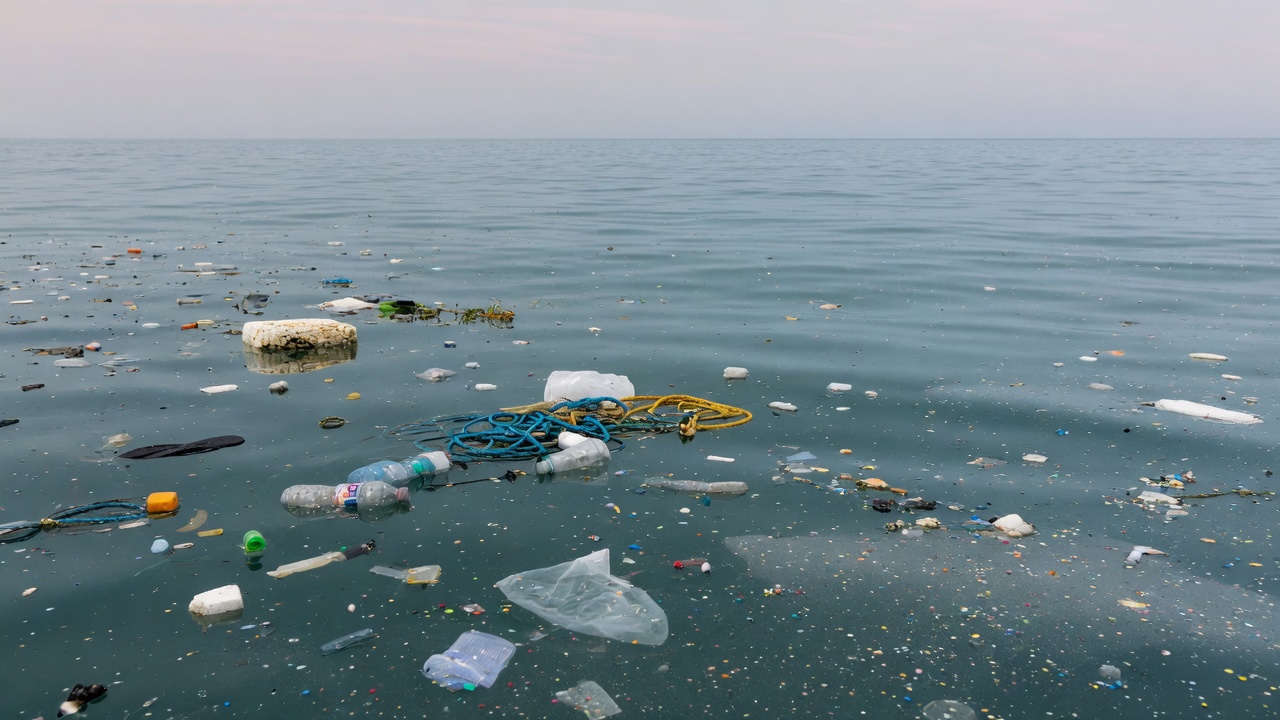
Despite the name, the garbage patch is not a solid island you can walk on. It is a region of the North Pacific where circulating currents—called a gyre—concentrate floating debris. Much of what is counted is small: fishing gear fragments, packaging remnants, and microplastics (generally particles under 5 mm).
Modern estimates associated with research and cleanup programmes describe on the order of about 1.8 trillion pieces of plastic floating in the Great Pacific Garbage Patch— roughly hundreds of pieces for every person on Earth—spread across an area often compared to a large US state or larger, depending on how the boundary is drawn.
From ocean plastic to human exposure pathways
Wildlife impacts are well documented: seabirds, turtles, and fish can mistake plastic for food or become entangled in nets and monofilament. When plastics enter the marine food web, chemicals associated with plastics may also move upward through bioaccumulation.
For people, exposure is multi-source. Microplastics have been reported in seafood, sea salt, drinking water, and household dust. Scientific agencies still emphasise uncertainty about dose, effect, and long-term clinical outcomes—especially for low-level, chronic exposure. That uncertainty is not a reason for complacency; it is a reason for careful measurement, better materials design, and reduced unnecessary plastic use.
Why this matters for wellbeing and long-term health
Longevity-minded living is not only about personal habits; it is also about the quality of the systems around us—air, water, food, and materials. Plastic pollution sits at that intersection:
- Food quality: marine protein remains a health asset when ecosystems stay clean enough to trust.
- Chemical load: plastics can carry or leach additives; research continues on endocrine and inflammatory pathways.
- Behavioural health: environments that feel degraded can raise stress and reduce outdoor, restorative activity.
- Prevention culture: reducing waste is a practical form of future-proofing communities and coastlines.
Put simply: cleaner materials and smarter consumption are not only “green” goals. They support the kind of low-toxicity environment that long-lived populations tend to prefer.
What has not changed since the early warnings
The 2008-era narrative was already pointing at durable truths that still hold:
- Plastic production and single-use convenience create a waste stream that outlives products by centuries.
- Currents redistribute debris far from the original dump site—including remote beaches and mid-ocean zones.
- Cleanup alone cannot keep pace if production and leakage continue to rise.
- Public incentives (deposit-return schemes, better design, less packaging) matter more than individual guilt alone.
Practical steps that support both planet and personal health
You do not need perfection to reduce exposure and leakage. Small, repeated choices compound:
- Prefer reusable bottles, containers, and shopping bags for daily routines.
- Cut unnecessary plastic packaging where alternatives are safe and available.
- Support local recycling and deposit-return systems—and vote for infrastructure that makes return easy.
- Choose natural-fibre textiles more often; synthetic fabrics shed microfibres in laundry.
- Filter drinking water if appropriate for your region, and maintain household air quality (dust is a microplastic reservoir).
- Back ocean-cleanup and source-reduction efforts that publish transparent impact data.
Bottom line
The Pacific plastic gyre is a visible symptom of a materials culture that was never designed for biological timescales. For Independent News for Longevity, the story is not fear—it is alignment: environments that stay cleaner for longer tend to support healthier people for longer.
We will keep updating this page as the science on microplastics and human health matures.
Note. Not a medical diagnosis. For personal health questions, speak with a qualified clinician.